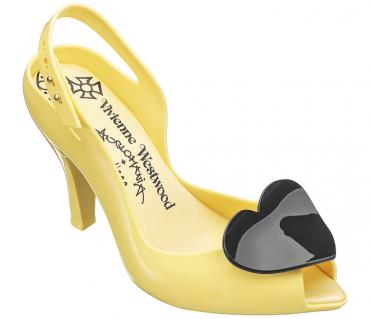
Vivienne Westwood recently teamed up with Melissa to create a new shoe collection. “The Fashion Audit: 02/02/09” in The Independent claims that these shoes are made from recycled rubber. The shoe company offers limited information on the details of the environmental factors associated with the plastic. One thing for sure, the shoes, like all Melissa shoes, are made from PVC (polyvinyl chloride). Now, I am no expert on PVC, that’s for sure, but I seem to recall the material being associated with some pretty serious safety and environmental risks. What’s changed? Apparently, at least one PVC manufacturer (Grendene), has been producing sustainable PVC since 1996?
Vancouver based Mountain Equipment Co-op (MEC) takes a clear stand against the use of PVC in its products. According to MEC,
“Polyvinyl chloride, known as “PVC” or simply as “vinyl”, is a common compound used in thousands of products. But for us and the planet, it’s bad stuff. During manufacture it produces potent carcinogens and toxins including dioxins, chlorine residue, and heavy-metal pollutants. Over their lifespan, PVC products can off-gas and leak some of their dangerous additives. PVC is difficult to recycle; most of it ends up in landfills. When burned, it releases further dioxins and gases such as hydrogen chloride.”
“Plastic is the chosen medium to communicate technology and renewal”
“Because our products are created from mono-materials they can be easily disassembled and recycled. Solid, liquid and gas residues, left over from our production process, are recycled and dealt with in-house. Nothing leaves the factory without being treated, resulting in practically zero waste.”
The company sources its PVC from Grendene, whose site offers no real information on the material. You can read the company’s Code of Conduct here, and a statement on PVC here
I have sent in an email to the people at Melissa, Vivienne Westwood, and Grendene requesting more information on PVC and will hopefully hear back and write more on the subject at a later date.
You can find “The Fashion Audit: 02/02/09” by Harriet Walker here
You can read more on Melissa’s sustainable plastic dreams, and the designers working with the company here
The issue of transparency is an important one. So, here’s a little blogging transparency … I write this ethical fashion blog on my ‘Made in China’ Espresso Brown Dell Inspiron 1525.
The National Labour Committee released a report today titled “High Tech Misery in China: The Dehumanization of Young Workers Producing Our Computer Keyboards” Sure enough, Dell is one of the companies manufacturing products in the Meitai Plastics & Electronics factory highlighted in the report in Dongguan City, Guangdong China.
According to the report, the base salary at the factory is 64 cents/hour. Minus room and board, workers take home 41cents/hour. Tax all in, my ‘made to order’ laptop set me back $620.48.
Other companies producing in the factory include Hewlett-Packard, Lenovo, Microsoft and IBM.
The Asian Human Rights Commission (AHRC) released a ‘Hunger Alert’ update today regarding the state of poverty and TB amongst handloom weavers in Varanasi, India. According to the report, the weavers are suffering from lack of medical attention, government neglect and extreme poverty and hunger. You can read the entire alert, as well as view a letter to the UN Special Rapporteur on the Right to Health and World Health Organisation calling for their intervention here.
What does this have to do with sustainable fashion design?
To say that the textile sector in India is vast would be an understatement. A decline in India’s handloom weaving industry has left these weavers without work to provide for their family, and created a situation where they are too ill to change their circumstance. Human Rights violations against the handloom weavers in Varanasi cannot be ignored. Sustainable solutions must include all aspects of the industry.
On a related note, the Centre for Sustainable Fashion released information this week regarding the Shared Talent: India competition. This competition will showcase sustainable textiles in India. For more information on the competition, see here.
According to this article by Eco-Textile News, although 2008 saw an increase in demand for organic cotton by 33%, global production was left with an 8% surplus. The article cites information released by non-profit Organic Exchange, who also claim that demand for organic cotton will likely result in a 24% increase in 2009 an worry that inventory will remain too high.
The Organic Cotton Market Report will be available in Feb 2009 for review.
This is a one day conference that will bring together experts in ethical fashion, as well as students and tutors, to discuss the current state of the ethical fashion industry, and ways to put ethics into practice. There is no question this will be an excellent conference.
You can read more about this year’s conference and speakers here.
To read a report on last year’s event click here, or to listen to a podcast, click here.
Another interesting article taken from The Independent today, discussed some frustrations in dealing with products that not only fall apart, but are designed to fall apart.
Consumer complaints in the UK surrounding poorly made clothing increased by 22% in 2008, according to this article by The Independent. The article cites a report by Consumer Direct released today. It claims that the biggest consumer complaint amongst females came from ‘defective goods’, at 34%.
According to the article, “[i]n the past five years, with the rise of “value” retailers, the price of clothing has fallen by as much as 25 per cent, while shoppers have bought almost 40 per cent more garments. This suggests fast fashion may be behind the increase in problem items.”
The article also cites statistics from another report, released by Global Cool, stating that female shoppers spent £11 billion on clothes that were never worn last year.
Fast fashion has created systems that cycle through clothing at a speed impossible for consumers to keep up with, and impossible to produce proper value items.
A recent report by The Boston Consulting Group, “Capturing the Green Advantage for Consumer Companies,” surveyed the green consumer purchasing habits of 9,000 shoppers across nine countries.
One section of the report showed that consumers vary their green purchases by product category (see Exhibit 6 in the report). While 14% have bought green before, but are not buying it now and 28% are buying green sometimes, 50% have never bought green. Only 8% of survey participants buy green systematically. As a result, ‘Textiles and clothing’ was listed as the third lowest category.
The report also states the need for companies to keep potential consumers informed with green credentials. These days, what’s in a credential anyway? The report showed that almost survey participants “reported being confused when shopping for green products and uncertain about exactly what being green means, what benefits it provides, and how to tell if a product is green” (18).
The full report is available in PDF here and is worth a read if you are interested in green/ing consumer habits.
If you’re interested in sustainable design, check out the Compostmodern 09 conference. The event will be available as a webcast, so you only have to worry about the long commute to your office, living room, kitchen table, or bed to get there.
Nathan Shedroff/MBA Chair, California College of the Arts (CCA)
Michel Gelobter, John Bielenberg and Pam Dorr/Project M and HERO Housing Resource, Alabama
Emily Pilloton/Project H Design
Dawn Danby/Sustainable Design Program Manager, Autodesk
Emcee: Joel Makower/GreenBiz
What does this have to do with sustainable fashion?
Compostmodern is a design conference dedicated to creating a platform for discussion on sustainable design practices. The interdisciplinary nature of the conference has created a network of information sharing that is relevant to discussions in sustainable fashion/textile design practices, as design is interdisciplinary. Last year, Mark Galabraith, discussed the nature of the sustainable filters used to create outdoor clothing company Nau Clothing, Inc. In his presentation, Galabraith discusses the clothing company as wanting to participate in the industry not as a brand, but rather as a cultural movement.
Some of the design questions he mentions as particularly central to the development of Nau Clothing, Inc. are issues surrounding durability, ease of repair, multi-use, raw material (biodegradability and treatment of animals) and impacts within manufacturing processes. He also speaks of the challenges associated with harmonizing urban sensibility with outdoor performance in a way that questions the ‘aesthetic point for sustainability’.
What I found particularly interesting is the company’s warehouse approach (coupled with a showroom boutique) used to hold merchandise. Although customers are able to take their product home immediately, a 10% is available to customers who are willing to have their garment sent to them. The company also boasts a recycle program (end of life strategy) where old products can be reused to be transformed into new ones (polyester used as a post-consumer material)
The key to Nau Clothing, Inc. is flexible design.
Check out Galabraith, and other speakers from last year’s conference here.
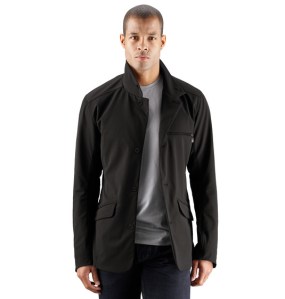
Check out more from Nau Clothing, Inc., like this men’s riding jacket, here.

 Dr Mary F Hanlon